
For most of the past few years, “AI at work” meant one thing: text. It drafted emails, summarized long documents, and answered questions. Useful, but fundamentally passive, it waited for a prompt and handed back words. Someone still had to read the output, decide what to do, and actually do it.
In 2026 that has changed. The conversation has shifted from AI that talks to AI that acts. This new generation, usually called agentic AI, doesn’t just suggest what to do, it does it. It takes a goal, plans a sequence of steps, makes decisions along the way, and executes them across your systems.
For anyone responsible for business processes, this is a genuine turning point. But it comes with a catch that most of the excitement conveniently skips over. Let’s look at what’s actually new, where the real risk sits, and why your processes, not the technology, will decide whether it delivers.

To understand what’s different, it helps to see agentic AI as the third wave of automation.
The first wave was classic automation and RPA: rule-based scripts that repeat a fixed set of steps. Reliable for predictable, high-volume tasks like data entry, but brittle, the moment something unexpected shows up, the script breaks.
The second wave was generative AI: smart, but passive. It could read and write impressively well, yet it sat on the sidelines waiting to be asked, with no ability to act on its own.
Agentic AI combines the intelligence of the second wave with the ability to do of the first, and adds judgment on top. A capable agent brings three things together:
The difference in a single line: traditional automation follows your instructions exactly, while an agent is handed a goal and works out how to reach itR

Here’s the part the hype tends to skip. An agent that can act across your systems can also act wrongly across your systems, at scale, and quietly, before anyone notices.
The failure mode of agentic AI usually isn’t that the agent can’t do the work. It’s that no one can see what it did, no one set clear limits on what it was allowed to touch, and no one built in a moment for a human to check before something irreversible happened. Wrong decisions, compliance gaps, and a missing audit trail are far more expensive than a task left undone.
That’s why the smartest voices in the industry have stopped asking whether agents are capable. In 2026 the real question is whether you can keep them under control.
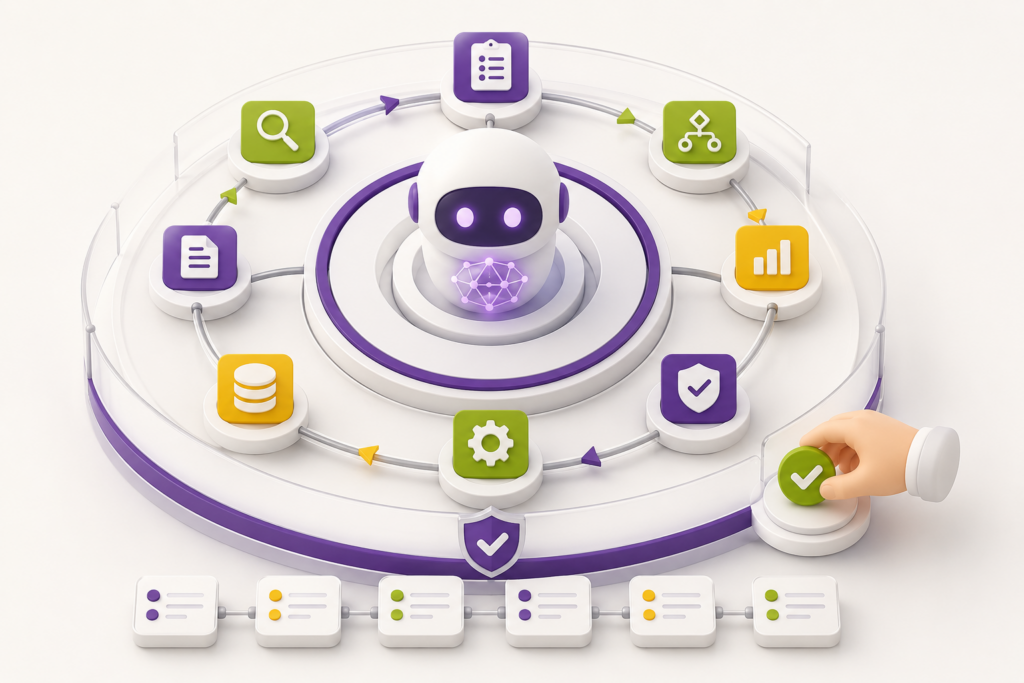
This is the insight that gets lost in most AI discussions: the problem of controlling an autonomous actor inside your organization is not new. It is exactly what business process management was built to solve, long before AI agents existed.
A well-managed process gives an agent precisely what it needs to be trusted with real work:
So agentic AI doesn’t make process management less relevant. It makes it more important than ever. Drop an agent into a messy, undocumented process and you simply get the mess, faster and at scale. Put the same agent inside a mapped, governed process and it becomes a reliable digital colleague.
This is no longer theoretical. Modern BPM platforms are building agents into the process rather than bolting them onto the side.
In WEBCON, for example, you can assign an AI Agent to a specific step in a workflow, give it its instructions in plain language, and let it act on each case that arrives, while it stays inside the guardrails you defined. It understands the context of the form and the process it runs in. It respects your field rules, and it will leave a field empty rather than guess when it isn’t sure. It has no access to technical system fields it shouldn’t touch. And every job it runs is queued and logged where you can review it. Alongside it, an AI assistant can help business users right inside the form, answering questions about a case, reading its attachments, and proposing the next action.
The specific feature names matter less than the architecture behind them. The agent operates within a governed process, with visible boundaries and a complete record of what it did. That is exactly the difference between an interesting experiment and something you can safely put into production.

The temptation with agentic AI is to automate everything at once. Resist it. The processes that pay off first tend to share three traits: high volume, clear success criteria, and enough variation to make an agent worth more than a rigid script.
A few practical principles:
Agentic AI is the most significant shift in automation in years, and the pull to move fast is real. But the organisations that win won’t be the ones that deploy agents the fastest. They’ll be the ones whose processes are clear enough, and governed enough, to let an agent work safely.
Agents amplify whatever process you give them. So map it, optimize it and then let the agent run it.
Wondering which of your processes are ready for agentic automation, and which need mapping first? That’s exactly the conversation we have with our clients. Get in touch and let’s find out together.